


Lambs, Shearing and Clearing Brush


We are 4 ewes into 10 that will lamb for us this year. 4 Gotlands and 6 Icelandics. We place bets on who will lamb next, and try to bribe the girls to free their little wooly prisoners. It's part of the fun of raising a primitive breed like Icelandics because the lambs come in all colors and patterns depending on what genetics you mix together. Our Ram was put in with our ewes in the middle of November, a sweet boy with beautiful charcoal and grey tendrils and a kind demenour. What he lacks in size, we have appreciated in his compliance. We watch for ewes that can birth easily, mother fiercly and produce rich milk that results in hearty lambs. Of the ewes that have birthed so far, 3 have been first timers, our O.W.E's. We call these girls 'One winter ewes' or O.W.E.'s. It is a bit of a gamble breeding ewes that are only in their 6-8th month (with a gestation of roughly 150 days) meaning they are just celebrating their own first birthday at the birth of their first lambs. We look for good grow out and strong constitution before breeding these youngsters. It is not our intent to keep and breed sheep that need to be left open (unbred) in their first winter and thus they are culled from the flock. Why? Mostly for logistical reasons. It would mean extra pens and infrastructure to keep them seperate and there are inevitably those that are so determined that they find any means necessary to escape. I have had to preform terminal C-sections on ewes that were accidentally bred that were not large enough and I'd prefer to avoid that at all costs. *Veterinarian care is not something that is a justifiable cost for our animals and so we do our best to make decisions that do not put ourselves in these scenarios

We spend a lot of time checking our Sheep Cam as our flock is being hosted by a gracious individual with an abundance of land and vineyards about 10 miles down the road from our home. And while there are challenges with not having our sheep next to our home, it's such a lovely spot for the flock that we take it in stride. Gas prices have us considering getting a horse and buggy as we do go up there at least twice daily. Once we're up there we find ourselves having a hard time leaving. The fruit trees are budding, birds are singing generously, the view of Mt Hood doesn't even look real half the time. Pair that with bouncing lambs and I find myself sighing contentedly with a childish grin plastered on my face in complete contentment.
This is also the time of year that I shear the sheep, or rather one of the times. Spring shearing of the icelandics is mostly to remove the hay flecked and matted wool and late summer/early fall is for shearing the clean, summer fleece. Either way, a long drawn out endevour that takes me many days as my hand can really only handle one shearing per day. I find that if I attempt more than one I start to get sloppy and rushed, and there's no need for that. Not while we have such a managable sized flock. I use blade shears, rather than electric for a few reasons. The first is cost. A nice pair of blade shears only set us back about $100 while the appropriate shears for our dual coated Icelandics would cost us somewhere in the ballpark of $500-1200. So until we have more than a handful of sheep, the blade shears suit us well. I also dont mind the quiet hour that I get to spend with each animal. Talking to them, examining their features, running my hands over their shoulders and rump, taking note of changes in their condition and fleece. It's been so heartening to see how well they've responded to some changes we made in their diet after procuring them.

Icelandics and Gotlands are both primitive breeds, meaning they are an ancient breed that largely went untouched for long stretches of time letting nature weed out the weak. This has resulted in animals that do more foraging for a variety of foliage, and you can watch them move across the pasture nibbling from shrubs and berry bushes, fruit tree leaves and saplings, broad leaf greens and forbs, grasses, and wildflowers. This makes all the sense in the world to me to offer them pasture with variety. Lately I've been craving vibrant spring greens like arugula, nettle, and raab and I imagine my sheep have their own cravings. How boring if they were only offered the same kind of grass day in and out! Aside from this salad bar of options, we also make sure they have access to kelp, dolomite, redmond mineral salt, and baking soda to cover their other mineral needs. I'll do a post dedicated just to minerals and sheep another time. It's fun and fascinating to watch your flock thrive when they have all their biological requirements met. While the paddock explodes with vibrant forage, we also move the flock frequently onto new areas to ensure that they aren't eating their favorites down to root. Grasses and forbs cannot regenerate if their is nothing less to capture sunlight and photosynthesize into new growth, and thus it is crucial that we move them when they've eaten down roughly half of the new growth on a plant. So while it may look like there's still plenty of food for them, we want to move them along to a new space before it looks like they've cleaned their plates so to speak.

While lambs are bouncing through the fields and we wait on the next round of expectant ewes, the meadow that the sheep graze has gone from the ghostly drab brown of winter in which you can see through limbs and stemy left-over stalks to a verdant green oasis. Spindly saplings are now thick hedges. Wirey vines are putting out new growth overnight and my eyes feel over saturated in green as I scan over the fields. While it may seem healthy and thriving from first glance, I see the work that needs to be done. Our culture has a complicated and confusing relationship with natural spaces. We see them as something to conquer or leave untouched. And while nature will indeed find the balance over time, we have created obstacles for her work by placing fences roads, digging culvverts and cement parking lots in the way. Spaces such as the one our sheep are on would normally be grazed by roaming elk and deer-the maintanance crews of meadows. And since the 8 foot high fence is doing its job of keeping them out, the grasses are left unchecked and the shrubs are unruly. Not to mention the lack of fertilization. And that is where our work is written for us. Our sheep will gladly step in as maintenance workers, but some clearing is requried beforehand so they can get into the thick brush and under the canopy of wild saplings. Opening up those spaces will leaving some of the young trees to act as shade and bird habitat while the sunlight can feed more plant life effectively and give our sheep an enticing reason to wander into the thickets.
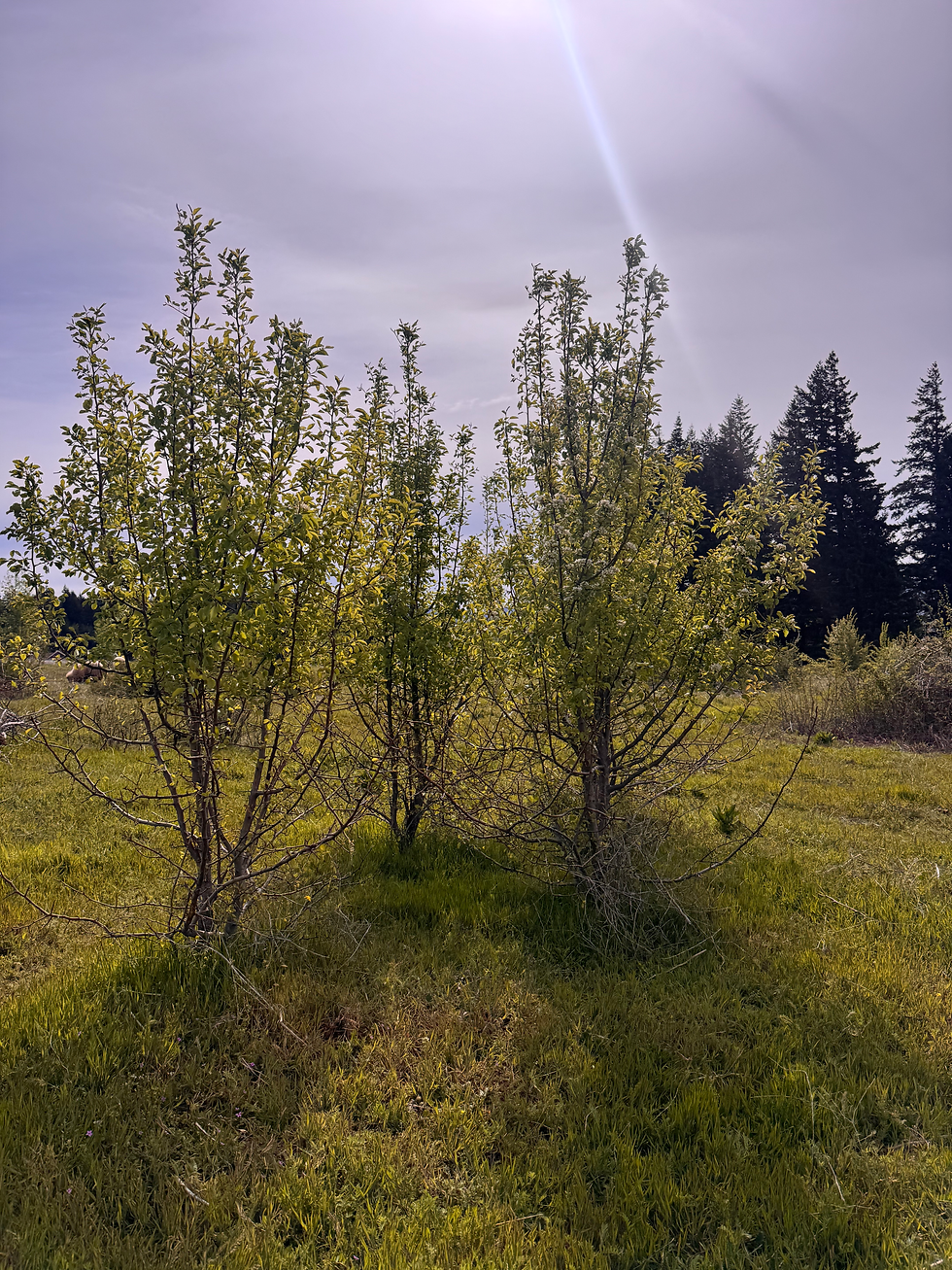


It is slow work. Bending, crouching, sawing, dragging and piling. At first I mutter under my breath as the spiny branches tangle in my hair and poke through my gloves. I slow down. I watch my step, what I grab, where I cut. Everything is at the same steady pace. Hours go by. Birds land near me, tilting their heads in curiosity. The ram comes sniffing up to my side wondering if he could grab one of the branches I just finished sawing down, apparently the leaves at the top are the tastiest. The sun and the flock move across the pasture as I walk from pile to pile heaping up future bonfires once the limbs and saplings have dried out. This is another added benefit to the pasture. Fire will add many readily available nutrients back to the soil and the animals will enjoy chewing on the bits of char too as needed. Come next year the burn sites will be extra dense with new growth.
These endevours-lambing, shearing and brush clearing are ways that we become part of the system. Necessary spokes in the wheel of tending soil and beast. As much as the grazing animals are stewards to the meadows, so to are we as we find our place. Not merely bystanders, but participants in a thriving ecosystem.

Comments